

We recognise our responsibility to reduce our environmental impact, and can achieve this through technology adoption, continuous improvements in operational efficiency, and doing things in new ways. The future success of our business will be subject to our ability to effectively manage climate related risks, as it would with all other risks that we face. We recognise the increasing threat that climate change poses, and the impact that the production and selling of products has on the environment. We recognise the importance of managing our impact through our value chain and of building decarbonisation into our decision making.
We have embedded the oversight and management of climate-related risks and opportunities into the overall risk management framework. We proactively assess, identify and manage climate-related risks, making proposals and reporting on progress to the ESG Committee and the wider Operational Board. We continue to monitor market disclosures with a view to ensuring that our own disclosures achieve the objective of being consistent and comparable over time.
We target reduced energy consumption and seek out renewable energy options when contracts are up for renewal and it is commercially viable to do so. We routinely make energy-efficiency conscious decisions across our properties – for example using LED lighting and installing solar panels at our York distribution centre and our York Head Office, and we moved to paperless statutory reporting and AGM voting.
Climate Report
We have embedded the oversight and management of climate-related risks and opportunities throughout our governance framework. Climate risk is a key component of our ESG strategy, for which the Plc Board has overall accountability. Execution of this strategy is delegated to the Operational Board.
The impact of climate change risk on our business and our impact on the world around is reviewed by the ESG Committee. Our ESG Committee meet regularly, making proposals and reporting on progress to our Operational Board. The ESG Committee is chaired by our Operations Director and comprises managers from all areas of the business who can credibly input into decision-making and implement agreed outcomes, ensuring that ESG is integrated across our business.
Our climate-related risks and opportunities are reviewed every two years to establish if they are still material, and to identify any new issues. The Audit Committee is responsible for providing oversight and governance of the Group’s internal controls and risk management, which includes ESG.
We have considered the transitional and physical risks and opportunities presented by rising temperatures, climate-related policy, and emerging technologies.
Physical risks arise out of the physical aspects of climate change, for example extreme weather events or global temperature increase. Market risks refer to changes in demand of certain products and commodities due to climate change. Transition risks are those which arise from the transition to a lower-carbon economy, such as policy changes.
The risks identified are more likely to present themselves in the medium or long term. Having assessed the risks, we believe that there is no material financial risk or threat to our business model in the short term. This risk assessment is under regular review.
Developments to keep under review included:
Policy/Regulation: It is likely that increased policy and regulation will have an impact on G4M over the longer term.
Market: Climate change is expected to impact the supply and demand for certain commodities, products and services. G4M will look to partly mitigate this risk by diversifying sourcing routes and product suppliers, and through growth of its second-hand business. We collect data from our product and carrier suppliers and started to use this information to identify our biggest risks and opportunities.
Due to the nature of our business, most of our carbon footprint falls outside of our direct control and is reported under our Scope 3 emissions. Our Scope 3 total emissions disclosure (CO2e) covers the complete lifecycle of all the products we sell. This extends from the production of raw materials through to the manufacture, transport, how our customers use them and the eventual end of life treatment of the products we sell.
Emissions are estimated in line with the GHG Protocol Corporate Accounting and Reporting Standard and are based on a combination of internal data and the best available public sources on CO2 emissions factors using conservative assumptions.
We report our scope 1, 2 and 3 emissions in our Climate Report in our Annual Report and Accounts.
Greener Delivery and Transport Solutions
We work closely with our courier partners to explore and implement more sustainable delivery solutions. While scalable low-emission delivery options remain limited, it is encouraging to see logistics providers investing in greener technologies and striving to make them commercially viable. As the market for sustainable transport solutions evolves, we are committed to working with our logistics providers to reduce emissions across our distribution network.
Our Products
We are committed to supporting long product lifespans and promoting responsible consumption. Our own brand products are intentionally designed with durability and repairability in mind, prioritising repair over replacement. While this approach may result in higher use-phase emissions over the lifespan of a product, it aligns with our goal to foster a more sustainable, circular economy by reducing waste and the need for premature replacement.
In accordance with the European ErP (Energy-related Products) directives and relevant legislation, we are continuously enhancing the energy efficiency of our electronic products—particularly in standby or idle modes—to ensure they consume minimal power when not in active use.
Our Sustainable Sound initiative actively offsets carbon emissions by planting a tree for every participating product sold. This supports global reforestation and directly contributes to reducing our overall carbon footprint. It’s part of our broader mission to make music more sustainable and to play a role in building a healthier, more resilient planet.
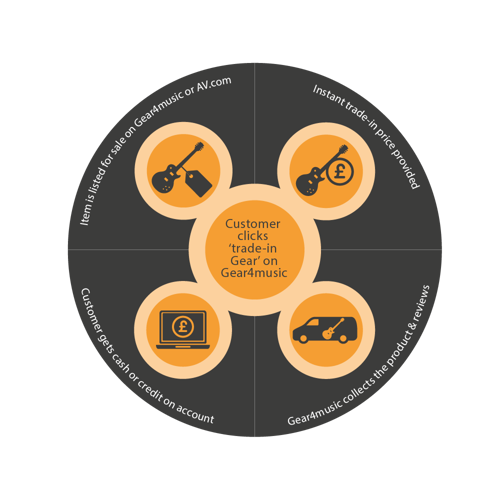
The durable nature of our products makes them prime for reuse, and our proprietary second-hand trade-in system reflects our commitment to the circular economy across our product categories. Our second-hand platform is part of our ongoing efforts to reduce emissions by encouraging the reuse of pre-owned musical instruments and equipment. We help to extend their lifespan, reduce landfill waste, and minimise the emissions associated with manufacturing and transporting new products.
Overview
Second-Hand trade-in system active across UK, EU & AV.com
Unique positioning within the market, designed to simplify equipment trade-in
In June 25, we had 22,900 products available for trade-in
Accepted condition ranges from ‘Excellent’, ‘Very Good’, ‘Good’ and ‘Fair’
Process
Waste Management
Packaging
We continually review our packaging efficiency and seek to reduce waste and minimise our environmental impact. Our approach prioritises the use of materials that are recyclable, responsibly sourced, and increasingly derived from recycled content. Wherever possible, we seek to design packaging that balances product protection with environmental responsibility, and we are working towards achieving near-100% use of recycled or recyclable materials across our packaging portfolio.
We are committed to using packaging responsibly by ensuring products are packed efficiently and appropriately. This includes selecting box sizes that are proportionate to the item being shipped, reducing unnecessary materials and void fill, and avoiding over-packing products that are already supplied in sturdy, protective manufacturer packaging. By taking a considered approach to how we package our products, we reduce material use, minimise waste, and lower the environmental impact of our logistics operations.
Waste
We separate and sell all our waste cardboard for recycling and actively seek ways to recycle more of our waste packaging materials such as plastic stretch wrap.
We have a specialist repair team and look to re-sell repaired own brand products where appropriate, and re-use spare parts from items which cannot be restored to full working order.
We promote safe and responsible recycling of end-of-life products, ensuring compliance with WEEE (Waste Electrical and Electronic Equipment) regulations to minimise environmental impact and support the recovery of valuable materials.
Climate related Risks & Opportunities
Transition and physical risks and opportunities have been identified, and a qualitative assessment has been carried out against a time horizon and financial impact as set out in the key below. Based on this assessment, we believe that there is no immediate material financial risk or threat to our business model.
We report our climate related risks and opportunities in our Annual Report and Accounts.